Clinical Assessment
Review the pattern and timeline of hair change, relevant history, and whether referral or laboratory evaluation may be appropriate.
- History
- Pattern
- Scalp health
- Referral when needed
A consultation-led approach to thinning hair that begins with candidacy, pattern, history, and realistic expectations before treatment is recommended.
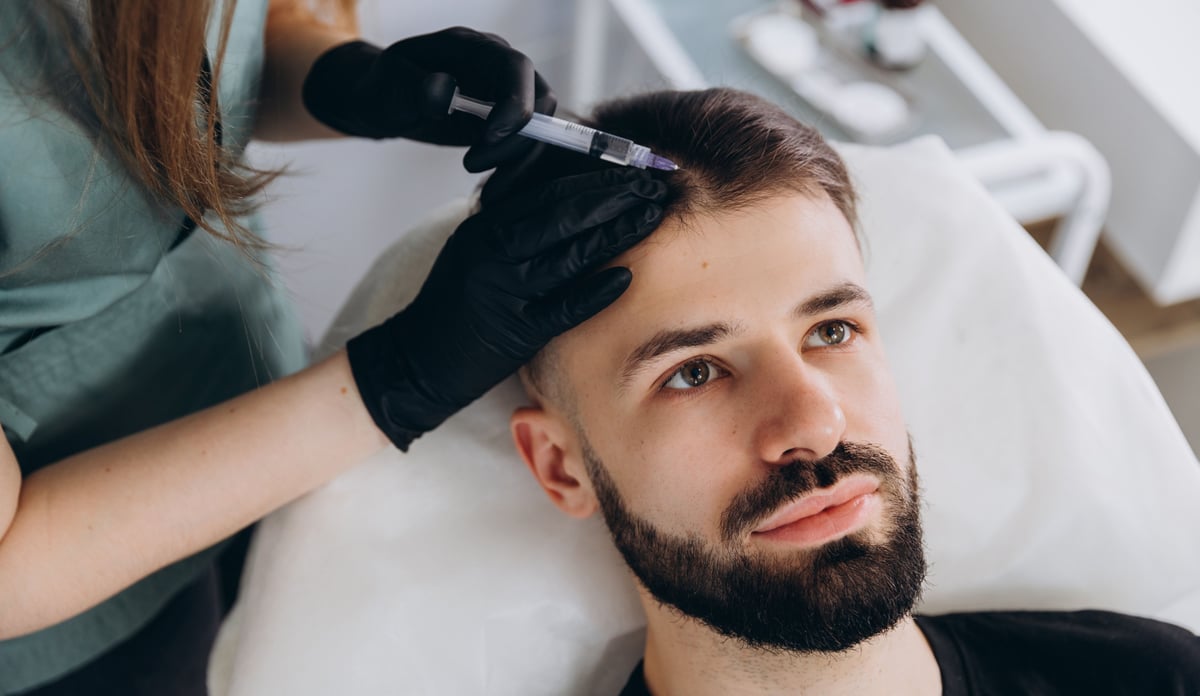
Different causes of thinning require different care. Before recommending an aesthetic treatment series, the practice considers pattern, timing, scalp symptoms, health history, and when dermatology or primary-care evaluation should come first.
Appropriateness and alternatives are assessed before treatment.
Technique and intensity are selected for your anatomy and goals.
Benefits, limitations, recovery, and risks are discussed directly.
Your plan can be staged and adjusted as your needs evolve.
Each option addresses a different concern. Consultation determines candidacy, sequencing, and whether another approach is more appropriate.
Review the pattern and timeline of hair change, relevant history, and whether referral or laboratory evaluation may be appropriate.
For appropriate candidates, a treatment series may support the appearance of density and healthier growth.
Hair restoration requires patience, standardized photography, and realistic discussion of maintenance.
Your concern, health history, prior treatment, timeline, and tolerance for recovery all affect the recommendation.
Where thinning is occurring and how it has changed.
Medications, stressors, hormonal changes, and scalp symptoms.
What treatment may improve and when referral is more appropriate.
Photography and consultation help establish a useful baseline. Individual outcomes vary and no specific result can be guaranteed.

The pattern and timeline of thinning guide next steps.

Treatment should follow evaluation rather than a generic package.

Standardized photos help evaluate change over time.
Individual results vary. Images and descriptions are educational and do not guarantee an outcome.
Discuss onset, pattern, family history, medications, recent health changes, and scalp symptoms.
Determine whether an in-office aesthetic treatment is appropriate or whether medical referral should come first.
If appropriate, follow a planned series with clear instructions and realistic timing.
Hair growth cycles are slow. Progress is evaluated over months, and maintenance may be recommended.

Lorie Carter, APRN, brings nearly 30 years of medical experience and more than 15 years of aesthetic specialization to every treatment plan.
Her approach is direct, educational, and centered on whether a treatment is appropriate rather than focused on selling a procedure.
That depends on the underlying cause. Pattern thinning may be approached differently from sudden shedding, patchy loss, scarring, or loss with scalp symptoms. Evaluation is necessary.
Hair growth is gradual. If treatment is appropriate and effective, visible change generally takes months rather than days or weeks.
A dermatology or primary-care evaluation may be recommended for sudden, patchy, painful, inflamed, or unexplained hair loss, or when other symptoms are present.
Many hair-restoration approaches require ongoing maintenance because they do not remove the underlying tendency toward thinning.
No. Response varies with diagnosis, age, health, treatment choice, adherence, and other factors.
Schedule with Lorie Carter, APRN, at St. Johns Aesthetics and Wellness Center.